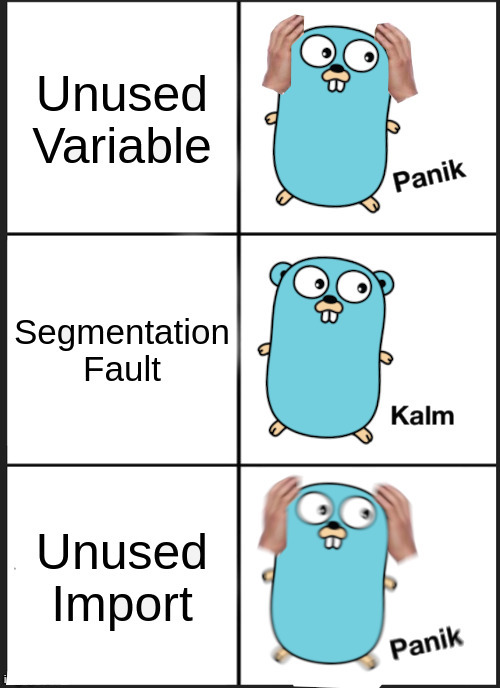
What reason is there for this when the compiler could just optimize that variable out of existence? This feels like the most hand holdy annoying “feature” unless I’m missing something.
If you need to take variable you don’t use for some reason (like it’s a function arg that has to follow an interface, but it doesn’t need a specific parameter in this case), then you can prefix it with an underscore.
If the language weren’t pushed by Google, nobody would pay it any attention. It’s yet another attempt to “do C right” and it makes some odd choices in the attempt.
…you don’t accept them. Basically every programming language accepts some kind of -werror flag to turn warnings into errors. Warnings for development builds, errors for production builds. This has been a solved problem for a very long time. Not only is it assinine to force them to be errors always, it’s semantically incorrect. Errors should be things that prevent the code from functioning in some capacity.
It’s a pretty standard flag in basically all compiled languages, just goes by a different name. -werror in C, -Werror in Java, TreatWarningsAsErrors in C#, etc.
*when I’m doing debugging that requires commenting out code.
Most of the time, I don’t comment out code. I run the code in a debugger, step through it, and see how the behavior deviates from what I expect. I mostly only resort to commenting out code if I’m having trouble figuring out where the problem is coming from, which isn’t that often.


Removed by mod
What reason is there for this when the compiler could just optimize that variable out of existence? This feels like the most hand holdy annoying “feature” unless I’m missing something.
Cleaner code. That’s all.
If you need to take variable you don’t use for some reason (like it’s a function arg that has to follow an interface, but it doesn’t need a specific parameter in this case), then you can prefix it with an underscore.
That’s what warnings are for and
-werrorfor production builds in literally any other language. This has been a solved problem for a very long time.Sure. Tell that to the Go devs.
If the language weren’t pushed by Google, nobody would pay it any attention. It’s yet another attempt to “do C right” and it makes some odd choices in the attempt.
Removed by mod
…you don’t accept them. Basically every programming language accepts some kind of
-werrorflag to turn warnings into errors. Warnings for development builds, errors for production builds. This has been a solved problem for a very long time. Not only is it assinine to force them to be errors always, it’s semantically incorrect. Errors should be things that prevent the code from functioning in some capacity.Removed by mod
It’s a pretty standard flag in basically all compiled languages, just goes by a different name.
-werrorin C,-Werrorin Java,TreatWarningsAsErrorsin C#, etc.Whoah, that seems like you’d flesh out code elsewhere, you know when you throw stuff together to make it work, and then fix it up to standards.
Feels like you should have to make git commits perfectly well before being able to compile…
Put that overwhelmingly intrusive thing in a hook checking out your commits instead (when you push your branch ofc).
You get used to it. The only time I really notice it these days is when I’m debugging and commenting out code.
So… A lot of the time?
“Nah, only when working…”
*when I’m doing debugging that requires commenting out code.
Most of the time, I don’t comment out code. I run the code in a debugger, step through it, and see how the behavior deviates from what I expect. I mostly only resort to commenting out code if I’m having trouble figuring out where the problem is coming from, which isn’t that often.